
What is RFID? How RFID Systems Work
RFID is the wireless, non-contact use of radio waves to identify and track objects, animals, or people - no line-of-sight required. This guide walks you through everything from the basics to building a complete RFID system.
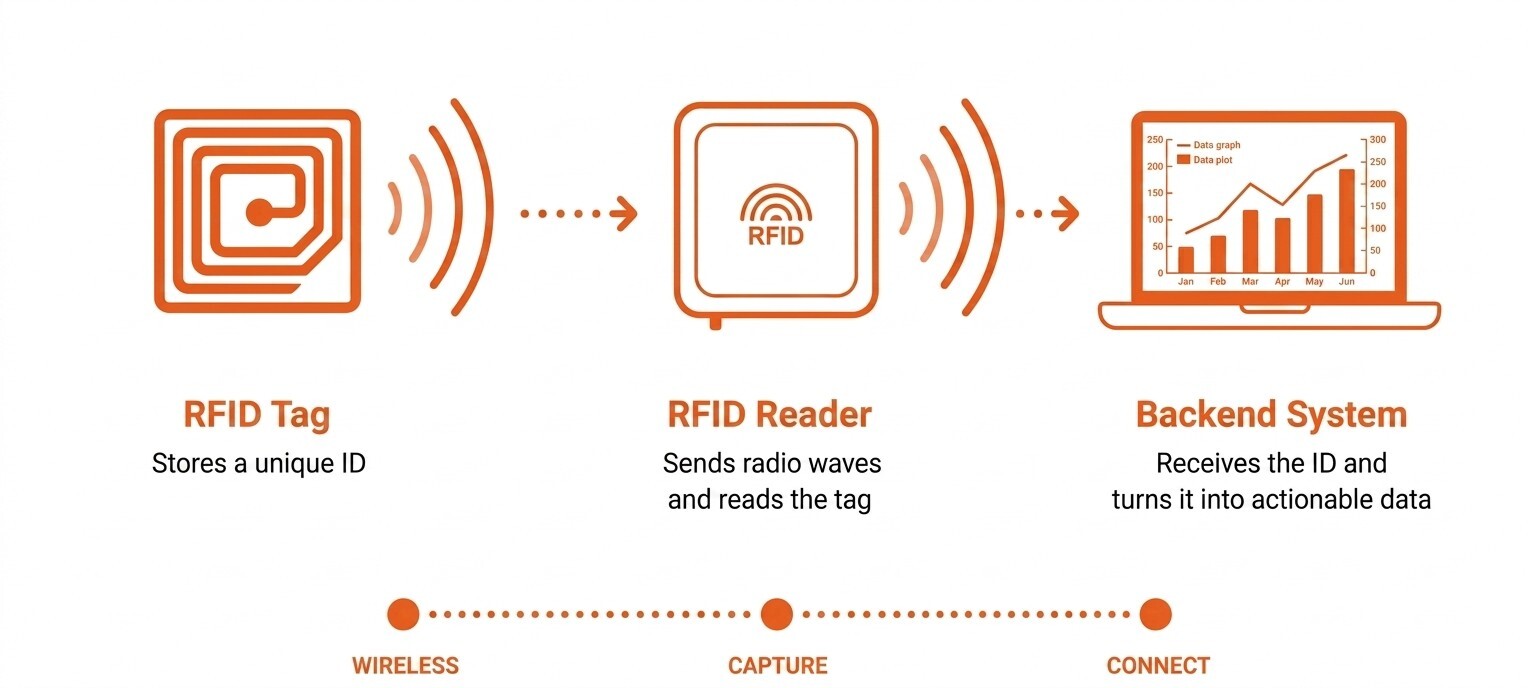
Table of Contents
What is RFID?
RFID stands for Radio Frequency Identification - the wireless, non-contact use of radio frequency waves to transfer data and identify objects, animals, or humans. RFID systems are typically comprised of three core components: an RFID reader, RFID tags, and antennas.
RFID is widely used across healthcare, retail, hospitality, manufacturing, and dozens of other industries. Think of it like barcodes - but without the line-of-sight requirement, and capable of reading multiple items simultaneously from a distance.
How Does RFID Work?
Tagging items with RFID tags allows users to automatically and uniquely identify and track inventory and assets. The process works like this:
The ability to uniquely identify each tag comes from a unique identifier stored in the tag's memory. This enables two physically identical items to be distinguished from one another with a single read - no contact or line-of-sight needed, at ranges of up to 30+ meters.
RFID has evolved considerably since its first application identifying aircraft as friend or foe in World War II. Both the technology and the cost of deployment continue to improve year over year. Learn more: RFID Failed You in the Past? It May Have Improved More Than You Think.
What is RFID Used For?
RFID applications span from broad use cases like inventory tracking and supply chain management, to highly specialized needs in specific industries. What makes RFID the right choice is the need to quickly and uniquely identify individual items at scale - where traditional systems fall short.
| Race Timing | Supply Chain Management |
| Pharmaceutical Tracking | Inventory Tracking |
| IT Asset Tracking | Laundry & Textile Tracking |
| File Tracking | Returnable Transit Items |
| Event & Attendee Tracking | Access Control |
| Vehicle Tracking | Tolling |
| Hospital Infant Tracking | Animal Tracking |
| Tool Tracking | Jewelry Tracking |
| Retail Inventory Tracking | Library Materials Tracking |
| Marketing Campaigns | Real-Time Location (RTLS) |
Types of RFID Frequencies
There are three primary frequency ranges used for RFID, each with different read ranges, costs, and ideal applications. Understanding the differences is essential when choosing the right technology for your use case.
Electromagnetic Spectrum & RFID Frequencies
Frequency
Frequency
Frequency
Frequency
Frequency
Frequency
Frequency
Frequency
Boundary
| Frequency | Range | Typical Read Range | Best For | Strengths | Tradeoffs |
|---|---|---|---|---|---|
| Low Frequency LF |
125-134 kHz | Contact to ~10 cm | Animal tracking, access control, high-liquid or metal environments | Reliable near liquids and metal; globally recognized standards | Very short read range; slower data rate; higher tag cost |
| High Frequency HF / NFC |
13.56 MHz | Near contact to ~30 cm | Library books, ID cards, NFC, ticketing, DVD kiosks | NFC compatibility; larger memory options; global standards | Short read range; lower data rate than UHF |
| Ultra High Frequency UHF |
860-960 MHz | Several feet to 10+ meters depending on setup | Inventory, supply chain, race timing, assets, logistics | Longer read range; fast multi-tag reads; low tag cost at scale | More sensitive to metal, liquids, tag placement, and environment |
Note: Actual read range and performance vary based on tag type, reader power, antenna setup, tag placement, and environmental conditions.
Ultra-High Frequency: Active vs. Passive RFID
Within the UHF range, there are two distinct types: Active (battery-powered) and Passive (reader-powered). The choice affects range, cost, and application fit dramatically.
Passive RFID Focus: Regional Frequency Standards
The global standard range for UHF Passive RFID is 860 – 960 MHz, divided into two primary subsets based on regional regulations:
What's in an RFID System?
While every deployment varies in complexity, a traditional fixed RFID system contains at least four core components. The simplest possible system is a handheld reader (with integrated antenna) plus RFID tags.
 |
 |
 |
 |
What is an RFID Tag?

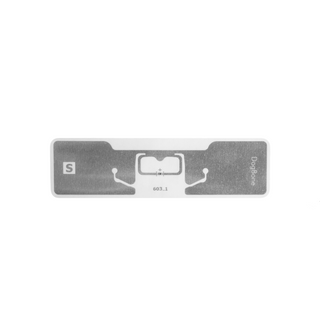
At its simplest, an RFID tag has two parts: an antenna (for transmitting and receiving signals) and an IC chip (which stores the tag's ID and other data). Tags are affixed to items so they can be tracked by a reader and antenna.
Most passive RFID tags have no battery - they harvest energy from the reader's RF field to power the chip and transmit a response. When the tag receives the reader's transmission, the energy runs through the tag's antenna, activates the chip, and the chip modulates and returns a signal with its stored data.
The Four Memory Banks
EPC Memory
Electronic Product Code – programmable, used to uniquely identify the item being tagged.
TID Memory
Tag ID – contains a unique, factory-locked identifier for the tag itself. Cannot be changed.
User Memory
Programmable bank for custom application data (not available on all tag ICs).
Reserved Memory
Used for access and kill passwords, and sometimes to expand EPC memory.
Types of RFID Tags
Tags can be categorized in several ways. The most common split is inlays (thin, flexible, $0.09–$1.75) versus hard tags (rugged, weather-resistant, $1.00–$20.00). Beyond that, tags are differentiated by:
How to Select an RFID Tag
Key Questions to Ask
| → | What surface material will you be tagging? (Metal, plastic, wood, liquid-filled containers, etc.) |
| → | What read range do you need? |
| → | Are there size constraints? (Max dimensions the tag must fit within) |
| → | Any extreme environmental conditions? (Heat, cold, moisture, impact, chemicals) |
| → | How will the tag be attached? (Adhesive, epoxy, rivets, cable ties) |
| → | The best approach: test multiple candidate tags in your actual environment on your actual items. Sample packs can be configured for your application. |
For a full selection framework, see our RFID Buyer's Guide and our free guide: A Guide to UHF RFID Tags.
What is an RFID Reader?
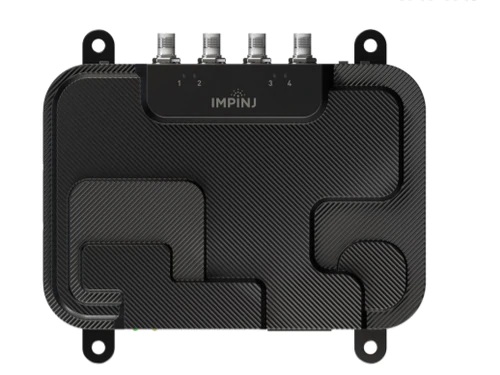
The RFID reader (also called an interrogator) is the brain of the system. It transmits and receives radio waves to communicate with RFID tags. Readers fall into three primary mobility categories:
How to Choose an RFID Reader
Key Questions to Ask
| → | How much read range does your application require? |
| → | Will the reader be fixed to a location or need to be mobile? |
| → | Does it need to connect to a network? (Wi-Fi, LAN, Bluetooth) |
| → | How many read zones do you need, and how many antennas per zone? |
| → | How many tags may need to be read simultaneously? |
| → | Will tags be moving quickly through the read zone? (e.g., race bib vs. slow conveyor) |
| → | Any harsh environmental conditions? (Temperature, moisture, dust, impact) |
For a full selection guide, see our RFID Buyer's Guide and our article: An Intro to RFID Readers: Basic Options and Features.
What is an RFID Antenna?
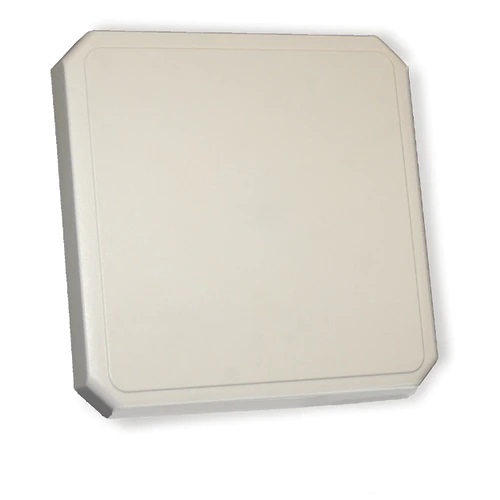
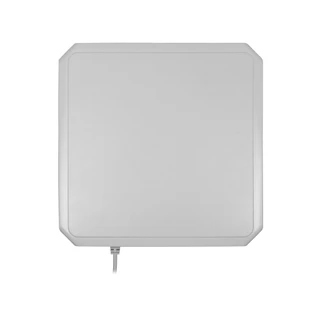
RFID antennas convert the reader's signal into RF waves that can be picked up by nearby tags. Without an antenna (external or integrated), the reader cannot communicate with tags. Antennas are considered “dumb devices” - they have no computing power and cannot power on independently.
The antenna's efficiency at focusing energy in a specific direction is called its gain. Higher gain = more powerful, longer-reaching RF field, but in a narrower direction.
Antenna Polarization
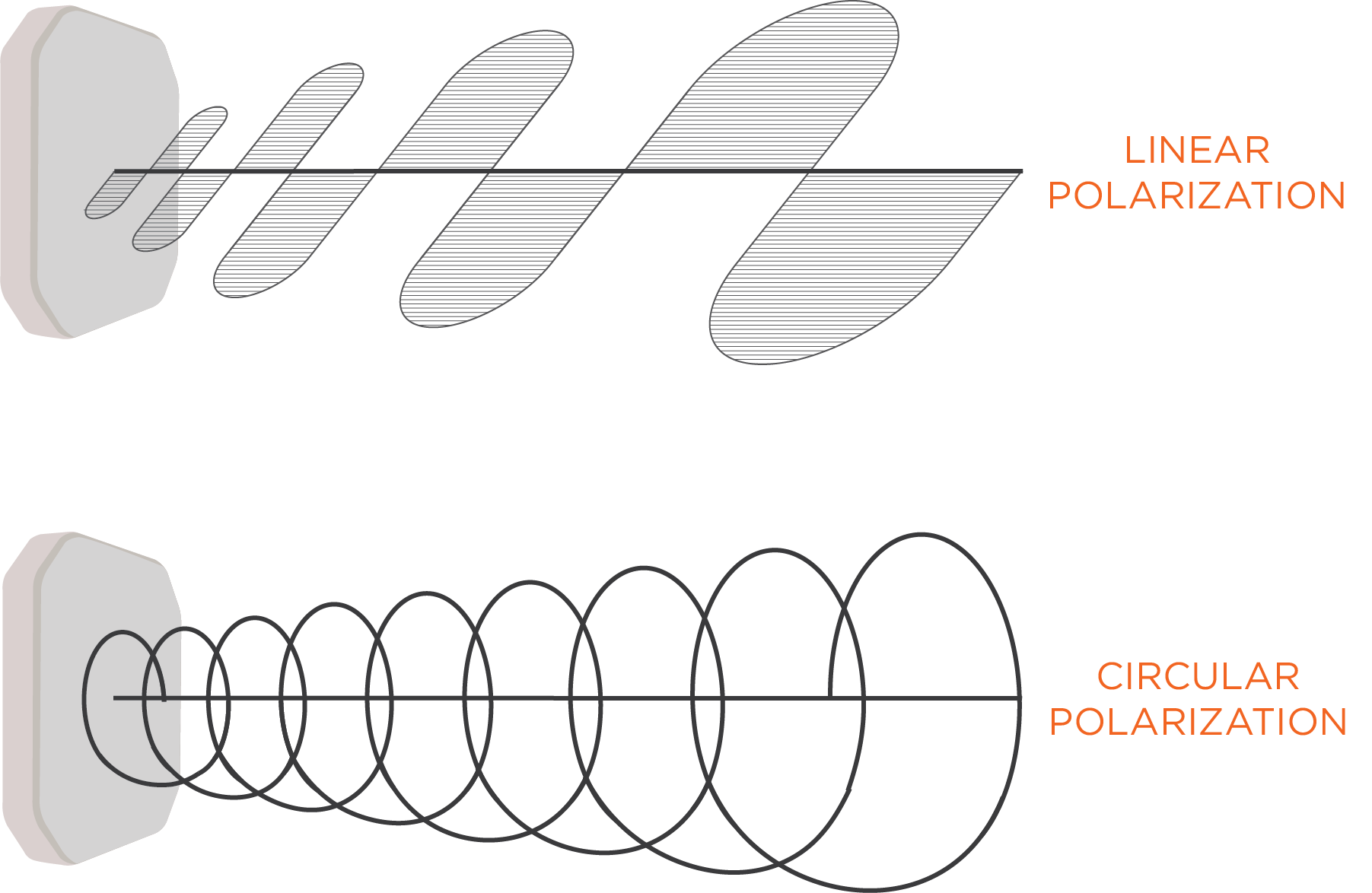
How to Select an RFID Antenna
Key Questions to Ask
| → | How much read range do you need? |
| → | Can you consistently control the orientation of tags relative to the antenna? |
| → | Will the antenna be installed indoors or outdoors? |
| → | Are there size or mounting constraints? |
| → | Any extreme environmental conditions? (Heat, moisture, impact - e.g., race timing mat antennas) |
Most antennas are priced between $50 and $300. Specialized ground/mat antennas (e.g., for race timing) can cost significantly more. See our article: 9 Tactics for Choosing an RFID Antenna.
RFID ROI & Frequently Asked Questions
What is RFID's Return on Investment (ROI)?
Before deploying any RFID system, two feasibility checks should be completed:
Fixed vs. Recurring Costs
Watch the RFID Video
Ready to Go Deeper?
This guide covers the fundamentals - but there's much more to explore when it comes to implementing RFID in the real world.
Explore Resources → Speak with an RFID SpecialistAbout the Author
Suzanne Smiley Gotfryd
Suzanne Smiley Gotfryd is a longtime RFID industry writer and subject-matter expert with over 10 years of experience publishing on RFID technology, asset tracking, inventory management, and IoT applications. Through her work with Atlas RFID, she has built a strong reputation for translating complex technical topics into clear, practical guidance for businesses adopting modern tracking solutions.
More Resources
Shop RFID Products
Browse our full catalog of readers, tags, antennas, and complete starter kits.
Shop All RFID → Starter KitsNeed Help?
Our team can help you scope your application and recommend the right hardware.
Request a Quote Contact Us