Tackling Hospital Waste: How RFID Improves Medical Inventory Management
Hospital supply chains face constant pressure. Patient volumes fluctuate, clinical needs change quickly, and regulatory requirements continue to grow. In this environment, inventory waste becomes more than a cost issue.
Common inventory challenges include:
- Expired products
- Misplaced supplies
- Last-minute shortages that impact both budgets and patient care
Many hospitals still rely on manual counts, spreadsheets, or periodic audits to manage medical inventory. These methods provide only a snapshot in time and often require staff to pause critical work to perform counts. Radio frequency identification, or RFID, offers a different approach by providing real-time visibility into medical supplies across the hospital.
- Why Hospital Inventory Waste Happens
- How RFID Changes Inventory Visibility
- Reducing Expired Supplies and Overstocking
- Preventing Stockouts of Critical Items
- Supporting Efficient Labeling and Identification
- The Role of Zebra Technology in RFID-Enabled Hospitals
- How Atlas RFID Helps Hospitals Move Forward
- A Practical Path to Reducing Waste
Why Hospital Inventory Waste Happens
Medical inventory waste is rarely caused by a lack of effort. In most cases, it stems from limited visibility.
Supplies are often spread across multiple storage locations, including:
- Central supply rooms
- Nursing units
- Procedure areas
- Mobile carts
Without continuous tracking, items can expire unnoticed or be reordered unnecessarily because staff cannot confirm what is already on hand. At the same time, critical items may run out unexpectedly, forcing emergency purchases or delayed procedures.
Manual inventory checks also introduce variability. Counts may be:
- Performed infrequently
- Documented inconsistently
- Delayed due to staffing constraints
By the time a discrepancy is discovered, the opportunity to correct it has often passed.
How RFID Changes Inventory Visibility
Real-Time Tracking for Medical Supplies
RFID addresses these challenges by making inventory data continuously available. RFID-tagged supplies can be automatically identified and counted without requiring line-of-sight scanning or manual handling.
With RFID readers placed in storage areas or used during routine workflows, hospitals gain an accurate view of inventory levels in near real time.
This visibility allows supply chain teams to:
- Identify products approaching expiration
- Detect unexpected usage patterns
- Respond to shortages before they affect care delivery
Instead of relying on estimates or outdated reports, decision makers can act based on current data.

Reducing Expired Supplies and Overstocking
One of the most immediate benefits of RFID is its impact on expired inventory. When hospitals know exactly what they have and where it is located, supplies can be rotated more effectively.
Items nearing expiration can be:
- Prioritized for use
- Redistributed to areas where demand is higher
This same visibility helps reduce overstocking. Rather than ordering excess supplies as a safety buffer, hospitals can replenish based on actual usage trends. Over time, this leads to leaner inventory levels without increasing risk.
RFID data also supports better forecasting. Patterns that are difficult to identify through manual processes become clearer when inventory movement is tracked automatically.
Preventing Stockouts of Critical Items
Stockouts create stress for clinical staff and can delay patient care. RFID helps prevent these scenarios by alerting teams to low inventory levels before supplies are exhausted.
Because RFID counts do not depend on scheduled audits, shortages are identified sooner. This allows procurement teams to replenish inventory proactively rather than reactively.
In high-acuity environments, this can make a meaningful difference in operational stability.
Supporting Efficient Labeling and Identification
Durable Labels for Healthcare Environments
Effective inventory management also depends on clear and consistent labeling. RFID and barcode labels must withstand healthcare environments, including frequent handling, cleaning, and temperature changes.
Using reliable printing solutions and durable media helps ensure that labeled items remain readable and trackable throughout their lifecycle. Linerless printing can also support sustainability initiatives by reducing waste associated with traditional label backings.
These considerations are especially important when inventory data is tied directly to patient care workflows.

The Role of Zebra Technology in RFID-Enabled Hospitals
Hardware That Powers Reliable Data Capture
RFID systems rely on a combination of readers, printers, and media working together.
Key components include:
- Zebra RFID readers, which support automated inventory tracking across healthcare environments
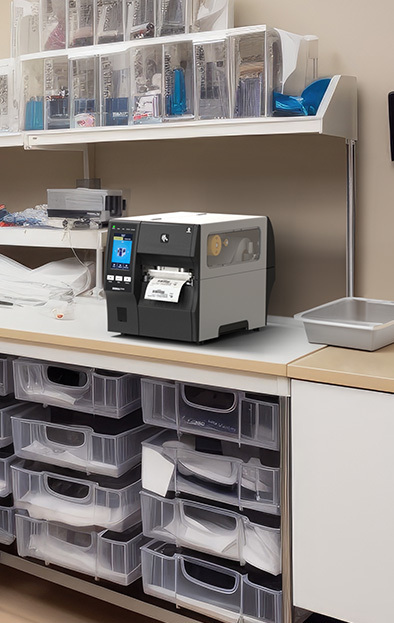
- Zebra printers, which enable consistent production of RFID and barcode labels at the point of use
- Zebra media supplies, designed to meet healthcare requirements so labels remain intact and readable over time
Together, these components form the foundation for reliable data capture without adding complexity for clinical staff.
How Atlas RFID Helps Hospitals Move Forward
Implementing RFID in a hospital setting requires more than hardware. Several elements contribute to a successful deployment:
- Workflow design
- System integration
- Change management
Atlas RFID works with healthcare organizations to design RFID solutions that align with existing processes and technology systems. By focusing on practical use cases and measurable outcomes, hospitals can improve inventory visibility without disrupting care delivery.
A Practical Path to Reducing Waste
Hospital waste is not an inevitable cost of doing business. With the right tools and approach, supply chain teams can gain the visibility needed to:
- Reduce expired products
- Avoid unnecessary purchases
- Ensure critical supplies are always available
RFID provides a practical, scalable way to move beyond reactive inventory management and toward a more efficient, data-driven model that supports both operational goals and patient care.
For healthcare organizations exploring RFID, working with an experienced partner can make the transition significantly smoother. Atlas RFID helps hospitals evaluate where RFID can deliver the most value, design systems that align with existing workflows, and implement solutions that integrate with current technology environments.
By combining RFID hardware, labeling solutions, and system expertise, Atlas RFID helps healthcare teams take a practical step toward more reliable inventory visibility and reduced waste.